
Leben und Arbeit/biography
György Galántai was born in Bikacs, Hungary in 1941. From 1963 to 1967 he studied painting at the College of Fine Arts in Budapest. From 1970 on he organised semi-legal exhibitions, actions and happenings in the chapel of Balatonboglár, which he had rented from the Catholic Church until it was closed down by the police. Galántai experimented with graphic art, visual poetics and sound poetry. In 1978 he send out the call “Please send me information about your activity” to the international Mail Art Network. With the received mail he founded the Artpool archive that – besides its focus on the new and alternative mediums in contemporary arts from the 1960s on – became the most important centre for documentation and research on Mail Art in Middeleastern Europe. After 1989 the archive was opened to the public, and since 1992 it has been receiving financial support from the city of Budapest. Galántai did various Mail Art projects, i.e. an hommage to Ray Johnson, performances (1980 together with Italian Mail Artist Cavellini). In 1983 he published the first issue of the Artpool Letters, and in 1988/89 he received a fellowship of the DAAD in West Berlin.
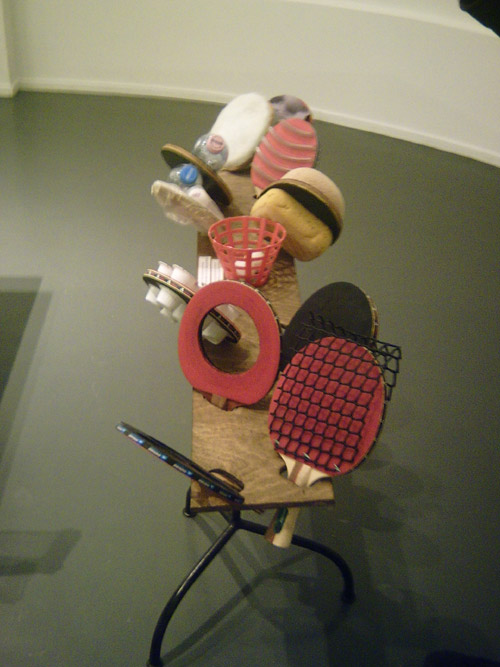
For some exhibitions he rebuilded works by George Maciunas, like his deformed ping-pong table with Fluxus table tennis rackets.
György Galántai wurde 1941 in Bikacs in Ungarn geboren. Er studierte von 1963 bis 67 Malerei an der Hochschule für Bildende Kunst in Budapest. Ab 1970 organisierte er halblegale Ausstellungen und Aktionen in der Kapelle von Balatonboglár, die er von der katholischen Kirche gemietet hatte, bis sie 1973 von der Polizei geschlossen wurde. Galántai experimentierte auch mit visueller Poesie und Tondichtung. 1978 versandte er den Aufruf “Please send me information about your activity” im internationalen Mail Art-Netzwerk. Mit dem eingesandten Material begründete er das Artpool-Archiv, das sich zum bedeutendsten Dokumentations- und Forschungszentrum für Mail Art in Mittelosteuropa entwickelt hat. Seit 1989 ist es öffentlich zugänglich und seit 1992 wird es von der Stadt Budapest finanziell unterstützt. Galántai führte verschiedene Mail Art-Projekte aus, u.a. eine Hommage an Ray Johnson, und machte Performances, 1980 z.B. mit dem italienischen Mailartisten Cavellini auf dem Budapester Heldenplatz. 1983 gab er die erste Nummer des Artpool Letters heraus. Er war 1988/89 Stipendiat des DAAD in West-Berlin.
Für Ausstellungen rekonstruierte Galántai auch Werke von George Maciunas, wie dessen verformte Tischtennisplatte mit den Fluxus-Tischtennisschlägern.
Ab Juni 2017 zeigt das Studienzentrum für Künstlerpublikationen an der Weserburg – Museum für Moderne Kunst in Bremen die Ausstellung Artpool.
Ausgewählte Arbeiten/selected works


Literatur (Auswahl)/literature (selection)
- György Galántai: “György Galántai antwortet auf Fragen: Fluxus + Konzeptuell = Kontextuell”, in: Katalog Fluxus East, Künstlerhaus Bethanien Berlin 2007 (de, en), S. 141 – 156.
- Galántai – Lifeworks 1968–1993 (ed. by G. Galántai and J. Klaniczay), Artpool – Enciklopédia Kiadó, Budapest, 1996, 320 p, (English–Hungarian)
http://www.galantai.hu/ - Parastamp. Four Decades of Artistamps, from Fluxus to the Internet. – exhibition catalogue, Szépművészeti Múzeum, Budapest, 2007, 108 p, catalogue of the exhibition from the artistamp collection of Artpool Art Research Center, with an introduction by Peter Frank, an essay by Kata Bodor and an interview with György Galántai (English–Hungarian)
http://www.artpool.hu/Artistamp/Para/index.html - György Galántai and Júlia Klaniczary (Eds.): Artpool – The Experimantal Art Archives of East-Central Europe. History of an active archive for producing, networking, curating and researchiching art since 1970, Budapest 2013 (en). ISBN 9789630872256
- Radek Krolczyk: Rebellion in der Vitrine. In der taz vom 17.06.2017 (de)
- THE MUKHINA PROJECT. Interpretations of Being in György Galántai’s Oeuvre. Edited by Júlia Klaniczay, text: Conversations about the Mukhina Project with György Galántai, VINTAGE Galéria, Budapest, 2018 (144 pages, 180 illustrations), 20×26 cm (English–Hungarian)
Links
- Artpool Archive (en)
 Mail Artists Index
14 thoughts on “György Galántai”