Posts

Ever Arts

Leben und Arbeit/biography

Ever Arts (Johan Everaers) was born May 12, 1949 in Dirksland, The Netherlands. He worked as a teacher of French language and has been doing Mail Art since 1984. He used to run a gallery specialised in Mail Art (Gallery Galerij) in a secondary school in Zierikzee (Holland). Mail Artists like Pawel PetaszJohan van GeluweRod SummersJoseph W. HuberKees FranckePiermario CianiBaudhuin SimonGuillermo Deisler, Anna Banana and Ko de Jonge etc. had solo-presentations there. He published about Mail Art and as a birdwatcher also about Birds. He created his own magazine “Leskimo” in 1997 and leads the imaginary country of “Birdland”. He is one of the three editors of the Dutch literary magazine Ballustrada. In 2013 appeared his book “Het Grote Gedicht” with stories about birds and mailart. 

Projects (selection)/Projekte (Auswahl):

  • “Professor Zeeman goes Crea” (1989)
  • “Birds & Borders” in cooperation with Rod Summers (1992)
  • “Oil Seal” (1994)
  • “Travelling Birds” (2007)

Ever Arts (mit bürgerlichem Namen: Johan Everaers) wurde am 12. Mai 1949 in Dirksland, Niederlande, geboren und ist von Beruf Französischlehrer. Mail Art macht er seit 1984. Seit 1989 betreibt er in Zierikzee eine kleine Galerie, die auf Mail Art spezialisiert ist. Dort stellten u.a. die bekannten Mail Artisten Pawel PetaszJohan van GeluweRod SummersJoseph W. HuberKees FranckePiermario CianiBaudhuin SimonGuillermo Deisler, Anna Banana und Ko de Jonge aus.
Er publizierte über die Mail Art und als Ornithologe auch über Vögel. Er schuf seine eigene Zeitschrift “Leskimo” im Jahr 1997 und führt das imaginäre Land “Birdland”. Er ist einer der drei Herausgeber des niederländischen Literaturzeitschrift Ballustrada. Im Jahr 2013 erschien sein Buch “Het Grote Gedicht” mit Geschichten über Vögel und Mail Art.

Ausgewählte Arbeiten/selected works

Literatur (Auswahl)/literature (selection)

  • Everaers, Johan: “Adres onbekend, postbus niet thuis”, in: Ballustrada 1998, nr 4. issn 0921-0148
  • Everaers, Johan: “Thema Kees Francke”, in: Ballustrada 2002, nr3/4. issn 0921-0148
  • Everaers, Johan: “MAILART IS A JOY FOR EVER ARTS”, in: Zeeland 2002, nr 4. issn 0927-1279
  • Everaers, Johan: See for more articles about mailart in Ballustrada
  • Everaers, Johan: “Het Grote Gedicht”, 2013
  • Everaers, Johan: “Verdwaalde oeverloper” (34 short stories), 2014
  • EverArts:  “Arthur Cravan”, Leskimo nr 4 2018
  • ARTSTAMPS AVIFAUNA, Johan Everaers & Jan Verschoore, Uitgeverij Liverse Dordrecht 2023  

Links

Lon Spiegelman

Leben und Arbeit/biography

Lon Spiegelman was born in 1941. He was an American Mail Artist and networker who initiated the concept called “Money & mail-art don’t mix” stating that Mail Art is non-commercial art and therefore can’t be bought or sold. He also coined the term “N-tity” with American Mail Artist Carlo Pittore, a term that refers to the spirit of networking and founded Spiegelmism Post. He was guest editor of “Umbrella” in the 1980s, a magazine originally started and edited by Judith A. Hoffberg. He had been doing Mail Art since the late 1970s. He died December 11, 2002 of a heart attack.


Lon Spiegelman wurde 1941 geboren. Als amerikanischer Mailartist und Networker seit den späten 1970er Jahren vertrat er das “Money & mail-art don’t mix”-Konzept, nachdem Geld und Mail Art nicht zusammen gehören. Mail Art war für ihn keine kommerzielle Kunst, sie sollte deshalb auch nicht verkauft werden. Gemeinsam mit Carlo Pittore prägte er den Ausdruck “N-tity”, der auf den Geist des Netzwerks verweist. N-tity steht dabei für Entität. Sie ist ein eindeutig zu bestimmendes Objekt, dem Informationen zugeordnet werden können, wie z.B. dem Kunden eine Kundennummer. Entitäten können aber auch miteinander in Verbindung stehen. Spiegelman publizierte seine “Spiegelmism Post” und war in den 1980er Jahren auch Gast-Herausgeber von “Umbrella”, einem Magazin, das ursprünglich von Judith A. Hoffberg ediert wurde.
Lon Spiegelman starb am 11. Dezember 2002 nach einem Herzinfarkt.

Ausgewählte Arbeiten/selected works

Literatur (Auswahl)/literature (selection)

  • Spiegelman, Lon: Help catalog : International mail-art show, Los Angeles, California, Otis Art Institute, 1980.
  • Spiegelman, Lon: Spiegelman’s mailart rag, Los Angeles, California, [1983 – ] (Periodical).

Links

Anna Banana

Leben und Arbeit/biography

Anna Banana was born Anne Lee Long on February 24, 1940 in Victoria, British Columbia, Canada. She trained as a teacher at the University of British Columbia. She was given her name in 1970 by her students at Vancouver’s New School after a crate of bananas fell into her at a party. She stopped teaching and moved to Big Sur, California, where she began using the name herself. She even made it official in 1985.

Anna Banana has been involved in the Mail Art network since 1971. At that time, she began publishing her “Banana Rag” newsletter in Victoria in conjunction with the “Town Fool” project. In 1973, she moved to San Francisco, where she collaborated with the Bay Area Dadaists. In 1974, she began publishing “VILE magazine,” and in 1975, she organized the first “Banana Olympics,” a parody of the Olympic Games. In 1978 she toured Europe with Bill Gaglione and their joint “Futurist Sound” performance, and in 1980 she toured Canada with “Toward the Future”.

As a member of the artist group Specific Research Institute, Dr. Anna Freud Banana performed parodies of psychological research projects with works such as “Proof Positive Germany is Going Bananas” (1993) and “Bananas in Distress” (1998). With her public events, she humorously questioned authority and let the audience participate in the creative work. Her “research projects” included “Tie a Knot on Me”, an interactive work that she presented in 2003 as part of Karla Sachse‘s project “crossing – knotting” at Berlin’s Nordbahnhof, as part of the “TranspOrtale” project that took place along the S2. Anna Banana invited passers-by to tie a knot in the colorful threads that she had sewn onto the back of her jacket. Her last research, “But is it Art? Where do you draw the line?” and “Tongue in check”, attempted to define art. They were presented in Rome, Cararra, Ghent, Minden, Berlin, Budapest, Bremen and Aalborg in 2009.

From the 1980s until almost recently, she published “Banana Rag”, “Artistamp News”, “The Artistamp Collector’s Album” and “International Art Post”. Anna Banana lived in Canada.

Anna Banana, a true pioneer and visionary of the art world, passed away on Friday, November 29, 2024.


Anna Banana wurde am 24. Februar 1940 als Anne Lee Long in Victoria, British Columbia, in Kanada, geboren. Sie machte eine Lehrerausbildung an der University of British Columbia. Ihren Namen bekam sie 1970 von ihren Studenten an der Vancouver’s New School, weil bei einer Party in eine Kiste Bananen fiel. Sie hörte auf zu unterrichten und zog nach Big Sur, Kalifornien, wo sie begann, diesen Namen selbst zu benutzen. 1985 machte sie ihn sogar offiziell.

Anna Banana beteiligte sich seit 1971 am Mail Art-Netzwerk. Damals begann sie in Victoria ihren “Banana Rag” Newsletter in Verbindung mit dem “Town Fool”-Projekt herauszugeben. 1973 zog sie nach San Francisco, wo sie mit den Bay Area Dadaists kollaborierte. 1974 begann sie mit der Publikation des “VILE magazine” und 1975 veranstaltete sie die erste “Banana Olympiade”, eine Parodie auf die Olympischen Spiele. 1978 tourte sie mit Bill Gaglione und ihrer gemeinsamen “Futurist Sound”-Performance durch Europa und 1980 mit “Toward the Future” durch Kanada.

Als Mitglied der Künstlergruppe Specific Research Institute führte Dr. Anna Freud Banana mit Arbeiten wie “Proof Positive Germany is Going Bananas” (1993) und “Bananas in Distress” (1998) Parodien auf psychologische Forschungsprojekte durch. Mit ihren öffentlichen Events hinterfragte sie auf humorvolle Weise Autoritäten und ließ das Publikum an der kreativen Arbeit teilhaben. Ihre “Recherche Projekte” umfassten “Tie a Knot on Me”, eine interaktive Arbeit, die sie 2003 als Bestandteil von Karla Sachses Projekt “crossing – knotting” im Berliner Nordbahnhof präsentierte, und zwar im Rahmen des Projekts “TranspOrtale”, das entlang der S2 stattfand. Anna Banana forderte Passanten dazu auf, einen Knoten in den bunten Fäden zu machen, die sie sich auf den Rücken ihrer Jacke angenäht hatte. Ihre letzten Recherchen “But is it Art? Where do you draw the line?” und “Tongue in check”, versuchten Kunst zu definieren. Sie wurden 2009 in Rom, Cararra, Gent, Minden, Berlin, Budapest, Bremen und Aalborg präsentiert.

Von den 1980er Jahren an bis fast zuletzt publizierte sie “Banana Rag”, “Artistamp News”, “The Artistamp Collector’s Album” und “International Art Post”. Anna Banana lebte in Kanada.

Anna Banana, eine wahre Pionierin und Visionärin der Kunstwelt, ist am Freitag, den 29. November 2024, verstorben.

Ausgewählte Arbeiten/selected works

Literatur (Auswahl)/literature (selection)

Links

György Galántai

Leben und Arbeit/biography

György Galántai was born in Bikacs, Hungary in 1941. From 1963 to 1967 he studied painting at the College of Fine Arts in Budapest. From 1970 on he organised semi-legal exhibitions, actions and happenings in the chapel of Balatonboglár, which he had rented from the Catholic Church until it was closed down by the police. Galántai experimented with graphic art, visual poetics and sound poetry. In 1978 he send out the call “Please send me information about your activity” to the international Mail Art Network. With the received mail he founded the Artpool archive that – besides its focus on the new and alternative mediums in contemporary arts from the 1960s on – became the most important centre for documentation and research on Mail Art in Middeleastern Europe. After 1989 the archive was opened to the public, and since 1992 it has been receiving financial support from the city of Budapest. Galántai did various Mail Art projects, i.e. an hommage to Ray Johnson, performances (1980 together with Italian Mail Artist Cavellini). In 1983 he published the first issue of the Artpool Letters, and in 1988/89 he received a fellowship of the DAAD in West Berlin.
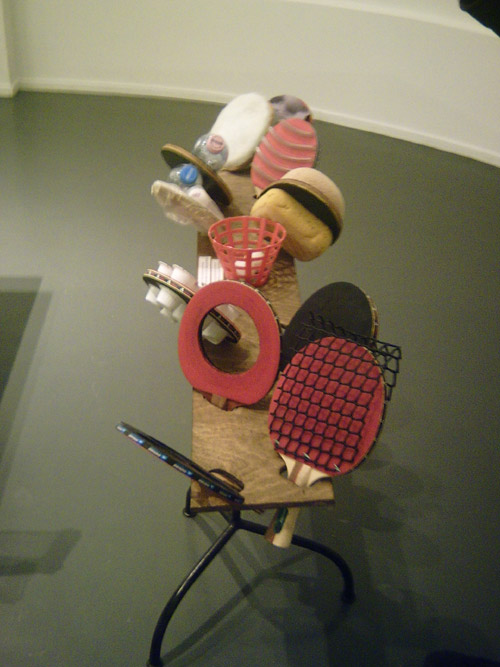
For some exhibitions he rebuilded works by George Maciunas, like his deformed ping-pong table with Fluxus table tennis rackets.


György Galántai wurde 1941 in Bikacs in Ungarn geboren. Er studierte von 1963 bis 67 Malerei an der Hochschule für Bildende Kunst in Budapest. Ab 1970 organisierte er halblegale Ausstellungen und Aktionen in der Kapelle von Balatonboglár, die er von der katholischen Kirche gemietet hatte, bis sie 1973 von der Polizei geschlossen wurde. Galántai experimentierte auch mit visueller Poesie und Tondichtung. 1978 versandte er den Aufruf “Please send me information about your activity” im internationalen Mail Art-Netzwerk. Mit dem eingesandten Material begründete er das Artpool-Archiv, das sich zum bedeutendsten Dokumentations- und Forschungszentrum für Mail Art in Mittelosteuropa entwickelt hat. Seit 1989 ist es öffentlich zugänglich und seit 1992 wird es von der Stadt Budapest finanziell unterstützt. Galántai führte verschiedene Mail Art-Projekte aus, u.a. eine Hommage an Ray Johnson, und machte Performances, 1980 z.B. mit dem italienischen Mail Artisten Cavellini auf dem Budapester Heldenplatz. 1983 gab er die erste Nummer des Artpool Letters heraus. Er war 1988/89 Stipendiat des DAAD in West-Berlin.
Für Ausstellungen rekonstruierte Galántai auch Werke von George Maciunas, wie dessen verformte Tischtennisplatte mit den Fluxus-Tischtennisschlägern.

2017 zeigte das Studienzentrum für Künstlerpublikationen an der Weserburg – Museum für Moderne Kunst in Bremen die Ausstellung Artpool. 

Ausgewählte Arbeiten/selected works

Literatur (Auswahl)/literature (selection)

  • György Galántai: “György Galántai antwortet auf Fragen: Fluxus + Konzeptuell = Kontextuell”, in: Katalog Fluxus East, Künstlerhaus Bethanien Berlin 2007 (de, en), S. 141 – 156.
  • Galántai – Lifeworks 1968–1993 (ed. by G. Galántai and J. Klaniczay), Artpool – Enciklopédia Kiadó, Budapest, 1996, 320 p, (English–Hungarian)
    http://www.galantai.hu/
  • Parastamp. Four Decades of Artistamps, from Fluxus to the Internet. – exhibition catalogue, Szépművészeti Múzeum, Budapest, 2007, 108 p, catalogue of the exhibition from the artistamp collection of Artpool Art Research Center, with an introduction by Peter Frank, an essay by Kata Bodor and an interview with György Galántai (English–Hungarian)
    http://www.artpool.hu/Artistamp/Para/index.html
  • György Galántai and Júlia Klaniczary (Eds.): Artpool – The Experimantal Art Archives of East-Central Europe. History of an active archive for producing, networking, curating and researchiching art since 1970, Budapest 2013 (en). ISBN 9789630872256
  • Radek Krolczyk: Rebellion in der Vitrine. In der taz vom 17.06.2017 (de)
  • THE MUKHINA PROJECT. Interpretations of Being in György Galántai’s Oeuvre. Edited by Júlia Klaniczay, text: Conversations about the Mukhina Project with György Galántai, VINTAGE Galéria, Budapest, 2018 (144 pages, 180 illustrations), 20×26 cm (English–Hungarian)

Links

Jarosław Kozłowski

Leben und Arbeit/biography

Jarosław Kozłowski was born in in Śrem, Poland in 1945. He is professor of arts at the Academy of Fine Arts in Poznań and one of the most well known conceptional artists in Poland.

From 1963 to 1968 he studied painting at the State College of Fine Arts in Poznań. In 1972 he – together with Andrzej Kostołowski – sent out the manifest NET together with a seven pages long address list to over 400 international artists, asking them to get into touch with each other and exchange ideas.

From 1972 to 1989 he organised his private Galerie Akumulatory 2 in Poznań, introducing various conceptional- and action artist from the West to Poland. In 1977 a four day long Fluxus festival with Fluxus music, -clinic and -sport took place in his gallery. In 1979 Kozłowski had a fellowship of the British Council and in 1984/85 of the DAAD in West Berlin. From 1991 to 1993 he was curator at the Centre for Contemporary Art in Warsaw.


Jarosław Kozłowski wurde 1945 in Śrem in Polen geboren. Er ist Professor an der Akademie für Bildende Kunst in Poznań und einer der bekanntesten Konzeptkünstler Polens.

Von 1963 bis 69 studierte er Malerei an der Staatlichen Hochschule für Bildende Kunst in Poznań. 1972 verschickte er – zusammen mit Andrzej Kostołowski – das Manifest NET mit einer siebenseitigen Adressliste an über 400 internationale Künstler, die aufgefordert wurden, direkt in Kontakt miteinander zu treten und Ideen auszutauschen.

Von 1972 bis 89 organisierte Kozłowski seine private Galerie Akumulatory 2 in Poznań, in der er u.a. zahlreiche Konzept- und Aktionskünstler aus dem Westen in Polen vorstellte. 1977 fand dort ein viertätiges Fluxus-Festival mit Fluxus-Music, -Clinic und -Sport statt. 1979 war Kozłowski Stipendiat des British Council und 1984/85 des DAAD in Westberlin. Von 1991 – 93 war er Kurator am Zentrum für Zeitgenössische Kunst in Warschau.

Ausgewählte Arbeiten/selected works

Literatur (Auswahl)/literature (selection)

  • Nader, Luzia: “Hetrerotopien. Das Netz und die Galerie Akumulatory 2”, in: Katalog Fluxus East, Künstlerhaus Bethanien Berlin 2007, S. 111 – 122.

Links

Design a site like this with WordPress.com
Get started